
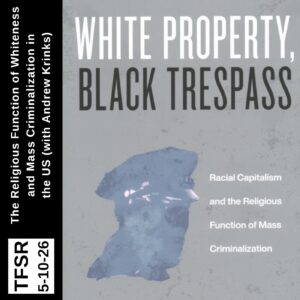
This week, we’re sharing an interview with Andrew Krinks, author of White Property, Black Trespass: Racial Capitalism and the Religious Function of Mass Criminalization from NYU Press, 2024. For the chat, we speak about taking a theological lens to the question of what ties exclusive private property, white masculinity, police impunity and mass incarceration in the US. We discuss aspects of Christian thought, employ concepts borrowed from the Black Radical tradition and try to get closer to the root of the sickness in our culture that flourishes from others pain.
To check out a Firestorm book event with the author and others about the book and related topics, check out this video!
. … . ..
Featured Track:
- TFSR by The Willows Whisper
. … . ..
Transcription
TFSR: Andrew, thank you so much for joining me here. I’m joined by the author of White Property, Black Trespass: Racial Capitalism and the Religious Function of Mass Criminalization, out from New York University Press, 2024, and we’re gonna talk about the book. Please introduce yourself with your pronouns, any location data, affiliations, or other stuff that you want to throw in here.
Andrew Krinks: Sure. My name is Andrew Krinks. I use he/him pronouns. I’m based in Nashville, Tennessee. I get into various abolitionist organizing in Nashville — housing justice organizing, organizing for safety beyond police, things like that. I have a small family: a partner and two young kids. When I’m not organizing, I’m trying to write and continue thinking. Glad to be on here with you.
TFSR: Cool. Thanks for being here. Could you talk a bit about your relationship to religion and philosophy?
A: I was raised in a Protestant, evangelical Christian context in South Jersey outside of Philadelphia. Then I migrated to Tennessee to go to college and have been here ever since, so more than half my life now. I was raised going to church about three times a week — Sunday morning, Sunday night, Wednesday night — if not more than that. It was a big part of my life in ways that I have both had to unlearn things from that and also relearn, retain, and embrace things that I received from that upbringing. But it was definitely an integral part of my life.
I went through, as many people do, an experience around late high school. In my case, it was around the time of the post-9/11 wars in Afghanistan and Iraq. That was a period of existential crisis for me when my agnostic and atheist friends at school had a strong moral opposition to the war, which I shared. But all my church family, my church people, were beating the drums hard for the war. I remember the youth minister saying that we should “nuke them all” from the pulpit. I was caught in an existential crisis. This is my context — this church world, my life, my faith that I inherited and grew up with — and yet my friends who hold no faith at school, were resonating with me more in terms of an opposition to the war.
I had no model, no context, no precedent for a Christian being opposed to war. I just hadn’t been exposed to it, and so I didn’t think it was actually possible. Little did I know that there is a great deal of tradition within the larger tradition of Christianity that is very opposed to war and all kinds of exploitation and oppression, including with its founder. So, I entered a period of trying to inhabit the tradition in a new way from that point forward. I do remain within the tradition, but in a very different way than I did when I was brought up. Really, the liberation traditions within Christianity are the only reason that I can remain within it.
Also, I studied religion, theology specifically, in my graduate and doctoral studies, and so I was able to go deep into the history of thought, and in all the messy and liberating ways that it shows up in the Christian tradition. I am both a practitioner, an inheritor, a student of, a scholar of, and someone who still wrestles with and critiques religion, particularly in its Christian manifestation.
Insofar as the study of religion is also a subset of the study of philosophy, a philosophical study, I have dipped into philosophy through my studies, different strains of philosophy. In the book, I briefly discuss some early modern philosophers; we can talk about more, including John Locke and others, because they’re helpful in understanding the world we live in now. That’s a bit about that.
TFSR: Cool. Thank you for that. I really enjoyed this book. As I said before the chat, it was a bit challenging because I’m not used to reading philosophy or theology, and you intertwine these with history really interestingly in this, touching on the mess that we’re in right now. Why did you decide to take a theological approach to the system of exclusive private property and otherizing criminalization in the US? What does the secular approach miss, maybe, or the ones that you’ve come across? What does it add to other explorations that you value?
A: One of the first reasons why I took this approach is that it was already the tool of thought and reflection that I was already familiar with in some regard — theological thought and reflection, and the critical study of religion, the tools that those disciplines and traditions afford. I was already situated to do so. My own trajectory, even from an early age, in retrospect, set me up for thinking about these things. In the preface to the book, I narrate a little bit about how, as a kid, like a lot of little white boys in the US, and particularly in a Christian context, I was really into cops — not the show, though, I watched the show too— but into police as a phenomenon and as a heroic mythology, and also soldiers, like GI Joe. There are plenty of pictures of me as a kid holding guns with GI Joes and little green army men lined up next to me. And I had a plastic riot police helmet. This was the late 80s, early 90s, and that was a big part of my life.
Christianity was also a big part of my life, and fear of criminals was also a part of my context. Growing up in South Jersey, watching the news out of Philadelphia every night. If you know anything about TV news in the early ‘90s, there’s quite a bit of anti-Blackness that permeates all aspects of TV news at that time. Of course, still today, but particularly at that time. I think, in retrospect, in the beginning of the book, I reflect on my fear of hell, which was a big part of my Christian upbringing, and is really inseparable from my fear of Black criminality that I inherited as a child, as a white kid. Therefore, the other side of that coin is my love of the good guys who keep people safe by defeating those enemies. My attempt to think theologically and to think about the religious dimensions of all of this, it’s helpful for me, in my own understanding, to trace that back to that early childhood context.
More recently, as somebody who’s in faith-based organizing contexts and in abolitionist spaces in the South, where every couple of people that you run into, even the most leftist folks, have some background in Christianity, often church-hurt or bad experiences of some kind. It’s pretty common to encounter. But others who still value things about those traditions, but are wrestling with them at the same time. So all that, plus the fact that I was pursuing a degree in Theology and Religious Studies, set me up to think all those things together.
I should also say that this is not just an object of study for me, the criminalization and incarceration stuff, and the whiteness and the property and all the capitalist traditions and all that. As somebody who was involved in organizing from the time right before I got to college and very much in college and after it, I had the opportunity to start going into the local men’s and women’s maximum-security prisons here in Nashville. I was the editor of a street newspaper sold by unhoused and formerly unhoused folks, and in that work, I got a lot of opportunities to listen to people’s stories and help them tell their stories about criminalization, the criminalization of their status as an unhoused person. It was very much a part of my everyday encounters in my ‘20s, learning and encountering the realities of mass criminalization and of white supremacy, and all the ways that I was learning about it.
Those are the contextual factors that organically led me there, but in terms of your question about why that approach to thinking about it, and what other approaches might miss… As a student of religion and also as someone who’s trying to understand systems of oppression, I have for a long time, had a real clarity about the fact that while the systems of oppression that undergird and animate everything about life in the United States and beyond in the colonial and imperial world. I have a sense that there are these mythologies that sustain them. That materialist analysis has given me so much in terms of understanding the systems that we experience and live under.
As I was writing this or finalizing it in 2021 and 2022 and editing it in 2023, I was like, “Okay, 2020 happened.” This was the moment where abolition entered the discourse at a mass level in a way that it had never done before. The largest, in terms of quantity, people on the streets, probably in all of US history, and the calls for defunding and divesting and abolition and all that. Why, then, was the system stronger than ever in the years following that? Why are the carceral systems and the systems of policing stronger than they ever were in the wake of the largest challenge to those systems? One of the ways that I was trying to answer that was because there’s something deeper here than just the material conditions. There are mythologies and religiosities and theologies that are sustaining and that we may not even have a clear sense of how much they animate and catalyze and sustain and prop up these material conditions that we’re experiencing.
My book embraces both materialist analysis and secular abolitionist scholarship, while also trying to think theologically with the categories and the sets of understanding that that scholarship gives us to try to go a little bit deeper into why we have what we have in terms of carceral systems and racial capitalism, and why it holds despite so much challenge to it.
TFSR: There are a few points, early in the introduction, when you start talking about religion, where you give some people’s definitions for the role that religion plays in society or in a personal practice as a way of explaining and fixing. It’s a story that we tell — a mythology, if you want to say it that way — about what the natural order of the universe is, how we can get right with that order and thus be on the good side of the good-bad struggle in the world. Breaking it down to such a small point helps, in a lot of ways, to pinpoint motivations that the most secular position, or the most materialist position, might be considered super-structural from a Marxist perspective; these ideas that are subconscious almost at this point, because they’ve been inculcated and reproduced at these levels that aren’t even talked about in those terms. I feel this approach really, harkening back to when you said watching the TV news in the late 80s and early 90s, and having these scenes in your head, maybe you were thinking of the Rodney King riots, and these images of Black and Brown folks, or just poor folks generally, rising up and burning, and then these armies of police and their orderly lines coming like Archangels or whatever, to bring order to this. It sounds literary, but this, for me, is touching on a thing that, as someone who is formerly religious, but who is not anymore, I ignore when I’m looking at the world. Like, what value do we place on this imagery? What symbolism do we apply here? And looking back to European history, where our juridical system comes from, where a lot of the stories that we tell each other about how the world works, there wasn’t a solid separation between theology and law.
A: I appreciate that, and I appreciate you also engaging with the book and finding something of value in it. It comes back to when the editors were like, “Who is the audience of this book?” I was like, “It’s a couple of different audiences, actually.” I’ve done book talks at churches about this, and it’s gone pretty well. I’ve done talks in very non-religious contexts, and so I appreciate that you don’t have to be a person of faith to read or get something from the book, obviously, because it’s largely a critique of the way that religion has shaped the world.
But I also want to say that when I say “mythologies,” I don’t mean to signify with that word just “something false.” More the idea of a guiding set of narratives and ways of perceiving and understanding and making meaning of the world. We all have mythologies, whether we recognize them as such or not. There are good and bad ones, I would say. But it’s not that we can escape them because we all have some way of perceiving and understanding the world.
TFSR: I appreciate that. Thank you.
Can you define racial capitalism in terms of how you use the phrase and talk a bit about the historical and philosophical development and deployment of it in the construction of senses of order in what you refer to as Euro-Christian traditions?
A: Racial capitalism is a term that more people are using these days. Inevitably, it can mean different things as more people pick up a term and use it. To some extent, that’s okay and organic. The first source of it is Cedric Robinson for me, who was a Black radical scholar and practitioner. He picks up the term from anti-apartheid organizing in South Africa, where they’re developing critiques of the system that they’re fighting against, and racial capitalism becomes one way of understanding what they were up against in that context. But then Robinson takes the term and generalizes it as a concept that helps us understand all of the West, basically, and what happens in Europe, and what happens beyond Europe with the rise of colonialism. He will say — and some of his interlocutors, like Robin Kelly, Ruth Wilson Gilmore, and others — that racial capitalism is a way of talking about capitalism. It’s not a different capitalism. It is capitalism. All capitalism is essentially racial. But interestingly, what Robinson is saying is that capitalism is racial before it ever leaves Europe. That might be a little confusing for folks, because whiteness and European-ness are somewhat synonymous, or become synonymous, in most people’s minds. But what he is pointing out, and others elaborate on, is that the development of capitalism really depends upon social differentiation. It really requires it and then exploits it. Where I come in with the way Robinson talks about racial capitalism is that he uses the words “racialist,” or “racialism,” which is prior to black and white for him. I think about that as somewhat proto-racial, as in, racial before the racial that we understand it to be today, but still sharing something with race as we understand it today, even if it wasn’t yet white and non-white, but that was germinating at that time. This is the beginning of capitalism, 1600-1700s, in the European context.
There are a couple of helpful ways of describing it. Ruth Wilson Gilmore talks about how in early modern rural England and across Europe, you had capitalist relations taking shape that were always racial, by which she means, “hierarchies among people whose descendants might all have become white, and those hierarchies depended for their structure on group differentiated vulnerability to premature death,” which is a mouthful, but it’s her way of talking about the idea that you differentiate between peoples, which becomes racial differentiation, and that differentiation is a way of determining whether you die early or not. Essentially, determining your lifespan based on social racial differentiation. The idea is that that’s inherent to capitalism. It’s required, and you can’t have capitalism without it.
I argue then, that it really takes more absolute form through colonialism, through the formation of whiteness and the formation of everything that is not white. I say it that way, specifically because whiteness constructs itself as the center of the universe around which all others revolve, and in relation to which they are contrasted. So Blackness is the primary contradiction against white in contrast to whiteness, but other forms of non-whiteness as well. I can get more to that in a minute.
But one quick example of this… I follow Marx in identifying the beginning of capitalism with the enclosure of land and the accumulation of land as the beginning of the system of capitalism. Essentially, privatization is the beginning point of capitalism as a system. But there’s a historian who I quote in the book, who talks about “enclosers” — these wealthy folks who set up fences and hedges around land that was otherwise held in common. They loathed, hated, so-called commoners, the people who inhabited that land in common with — and this is the historian’s term — a xenophobic intensity. These are all folks that today we would think of as white. But the enclosers, the wealthy privatizers of land and thieves of land, are loathing the commoners as if with a racial loathing, even if we would think of them all as white today. And so that’s part of what racial capitalism is getting at. That capitalism is essentially racial, and that it becomes more so as time passes and as it expands beyond the European context, through colonialism and later through imperialism.
TFSR: And that’s partially because there’s an entitlement that the enclosers feel that they have to exclusively withhold that from others, and then that’s justified by a spiritual order, right?
A: Exactly. That was the other part of your question about your Christian traditions. That phrase Euro-Christian, I get from an Indigenous theologian, George E. “Tink” Tinker, who uses that phrase to say “colonialism is Euro-Christianity, and Euro-Christianity is colonialism.” The theft of land, whether it’s the enclosers setting up hedges within the rural English countryside, or whether it’s the theft of Indigenous lands outside of the European context, it’s all undergirded and animated by these presumptions that God invites and even commands that enclosure, that private possession of land and of the earth.
This may be a place to transition into John Locke, if that’s okay. That was one of your next questions. He really is a figure who helps us understand what’s going on with Euro-Christian tradition, with possession and property, and also with whiteness. I’ll introduce Locke quickly and then elaborate a bit more on how understanding what he’s up to helps us understand the larger racial capitalist landscape and beyond.
Of course, first of all, he’s living in the 17th century, the 1600s. He’s a philosopher and a theologian. He is an investor in the slave trade, and has a great stake in it, as well as the enclosure movement across Europe and through colonialism in the Americas. He drafted the Constitution of the Carolina colony. I always tell people who are from so-called North Carolina today that he really hated North Carolina. It was Carolina before it was North and South. But he really hated North Carolina because he really saw them as these backward people. Before there was a notion of “white trash,” he was essentially channeling what would become that notion before it was a concept. He had this term that he used to describe people — renegados — which was both lawless and godless. It was both of those things combined. For those of you in the Carolina context, it’s maybe a badge of honor that John Locke hated people in that region so much.
TFSR: I would wear the badge.
A: Absolutely, it’s a badge worth wearing. He’s theorizing civil government and Western concepts of liberal democracy, which is quite fascistic in nature. For folks who don’t know, he is somebody that, for the framers of the Constitution in our country, in the US, reading Locke was reading the Bible for them. He was a primary source that helped frame the concepts of the constitutional framework in the US.
When it comes to the question of property, he will say that the primary purpose of civil government is to defend property. He will also talk about how it is appropriate, and even divinely ordained, in some sense, to use violence to protect property. Meaning the state uses violence to protect property, but also individuals use violence to protect property. By the way, this last week in Tennessee, our state legislature wrapped up its legislative session, and there’s a new bill that now grants the right of property owners to use mortal violence to defend their property. That’s essentially a Stand Your Ground type of law. So the legacy of Locke lives on very tangibly today, in my own context, and really across the US.
But in terms of Locke in relation to whiteness, it’s an interesting question. I like to ask students sometimes a trick question, which is, have there always been white people? It’s confusing, because there has long been a European context, but there has not always been whiteness. Whiteness is essentially the reduction of all the diversity of cultures within Europe into one monolithic whole. In that sense, it’s really a diminishment of a lot of the richness of tradition that is worth retaining in various European contexts, and flattening it into one thing. What Locke helps us understand is that whiteness and property possession are two expressions of the same capacity, reality, or power. Some of the folks that I quote in the book will talk about how he wouldn’t have yet called himself white, but his philosophical argumentation and his socio-economic practice — this is Tink Tinker talking, who I just quoted a minute ago — all of his work places him within the concept of European supremacist thinking, which becomes white supremacy.
There wasn’t yet the language of whiteness, which would come a couple of decades after he was writing, but he readied the ground for it. There’s also David Roediger, the historian, who talks about how Locke’s work made the idea of race and whiteness both possible and necessary. The one figure that I like to look at or quote, and he frames the second chapter of my book, is W. E. B. Du Bois, who defines whiteness as “ownership of the Earth, forever and ever, Amen!” A lot of folks find a lot of utility in that ownership of the Earth part, but tend to sometimes leave off the “forever and ever, Amen” part of it. Du Bois is a very literary writer, even as a sociologist, historian, and political theorist. But people sometimes mistake that as just a flourish that isn’t integral to the formulation. But actually think that the “forever and ever, Amen” of that definition is really the crux of it, in a lot of ways, because it points to the fact that whiteness is a presumption, an assumption of God-like power, a power that resembles the power to own the world. For those who aren’t familiar, “forever and ever, Amen” comes at the end of the so-called Lord’s Prayer introduced in the New Testament and repeated in churches and cathedrals around the world every day and every Sunday. It comes at the end of this prayer of confession that “to God be the power and the glory, forever and ever, Amen.” To put whiteness there, I interpret it as saying that whiteness takes the God-like position in the world. It exercises God-like power. It presumes that it is God in the flesh, a mortal God. In my second chapter of the book, I do a little thought experiment around “let’s look at the traditional attributes or characteristics of God that traditional, classical, Orthodox theology uses to understand who God is.” These ideas of God being absolutely transcendent, all-knowing, all-powerful, and all of these things. When you think about those and think about how whiteness behaves and thinks about itself, it’s striking how much whiteness appears to be aspiring to a God-like positionality and power in the world.
There’s another writer — Willie Jennings, a theologian — writing today, who says that whiteness comes into being as a landscape. He’s writing about the fact that some of the chroniclers of the earliest encounters between Europe and non-European peoples, African people specifically, were really described in deeply theological terms in which the colonizers have this God-like vantage point from which to look upon the peoples below them and determine their salvific capacities and whether they could be saved or not, and things that.
All this to say that I think of one way that I found myself formulating it in the book is that the color line — that’s the language from Du Bois, the “color line” of the racial differentiation — that the color line and the property line are basically one line, even if there’s complexity to it, like people who are not technically white can be owners of property, etc. But the color line and the property line are contiguous, but then also — this can get into where we might go next — that those two lines flow into and become the so-called thin blue line of police power. Maybe I’ll pause there for a moment. We can see where we want to pivot next.
TFSR: I wanted to also touch on the – out of fairness and clarity too – the term Euro-Christian. It doesn’t say that this is Christianity. It’s saying that this is the pathway of development that you can look at for certain versions of Christianity, right? It’s not necessarily baked into the foundational, even if it was, maybe, brought in and concretized in some applications of Christianity through different councils or creeds coming out of that, or liturgical practices within churches. It’s not necessarily foundational to Christianity. Is that right?
A: Yeah, and this is a big debate. I remember being at a Catholic church, actually doing a talk about the book, and somebody asked, “Is all of this stuff inseparable from Christianity, or is it just one stream of it?” Different people will answer that differently. I tend to answer that these manifestations of Euro-Christian traditions are, in some sense, a divergence from what I understand to be the essence of Christian tradition, but I also hesitate to say it’s a false Christianity, because that doesn’t do justice to the fact that millions of people around the world are very much invested in this. I don’t think it gets us all that far if we just say it’s not real Christianity. It has a legacy that’s very real with great devotional and spiritual investment. As opposed to, some people might reduce it to the idea that these were just bad people who decided to use the language of Christianity to baptize their ill intentions. I think that’s too reductionistic. A lot of these folks were deeply devoted to the tradition as they understood it, and it enabled them to do really bad things. But that was not just them putting on a Christian costume to do a bad thing; it was them thoroughly being Christian as they understood it, and doing some really bad stuff.
TFSR: This is the way that some people took that football and ran with it. But, at the same time, Christianity has also impacted a lot of different communities in the world that are outside of the context of the enclosure and colonization that European structures of power ended up embracing and moving along with, such as in North Africa and West Asia. I’m sure we don’t have to get into the question of what is the correct interpretation and the wrong interpretation, but more so to give space to say that this isn’t the only way that that story pans out, and it’s not the way it has panned out in different communities.
A: 100%, and also, even within colonized contexts, you have these counter-traditions within the tradition of liberating Christianities that exist in revolt against the colonial Christianity, the Euro-Christian Christianity. I like to say that there it’s never Christianity, it’s always Christianities. It is the same for every religious tradition that every tradition is multiple traditions combined into one.
TFSR: Cool. Thank you.
What’s the idea of carceral soteriology? Can you define that? How does it explain the dehumanization of modern prisons and the sweeping God-like violence of police?
A: Soteriology is one of those theological study words that is really just theories of salvation. The Christian tradition is anchored in many ways by a narrative of sin and salvation. Soteriologies are different accounts of what sin and salvation mean, how they relate to one another, what the passage from one to the other looks like, etc. Firstly, I have this word “carceral” in front of it, meaning incarceration and capture and caging to describe a certain stream of thought within the Christian tradition, to convey that there’s something carceral happening within one trajectory of Christian thought about sin and salvation, and that that helps us explain a lot of what goes on today.
The first thing that I want to say is that people talk about writing as an act of discovery in its best form. And the ideal form of writing is that you’re discovering things as you go. For me, one of the things that I discovered — that was shocking to discover because of how obvious it was, and that I didn’t see it until later in the process of writing this project — was the very intimate connection, etymologically, in terms of the history of words, between “salvation” and “safety.” That “to save” means “to make safe,” and “to make safe” means “to save,” essentially. As somebody who’s studying carceral realities and systems and criminalization and all of that, and also organizing around trying to expand understandings of what safety means, I hadn’t until I was writing this, really thought about the fact that salvation is central concept within Christianity, that is so deeply intertwined — almost inseparable at a deep conceptual level, before we even can reflect on it — and that is so close to the notion of safety. That linkage, to me, was part of a helpful framing that the book tries to offer: the pursuit of safety, by way of cops and cages, is a pursuit of salvation. People treat the safety, the alleged safety — which I don’t think is very much a safety worthy of the word — but nevertheless, a safety of some kind that people perceive, that they receive from the mere existence of police and prisons, that that in some sense is salvific, even if in a cognate sense, even if not in the sense of Jesus performing it for them, it’s still something resonant and related to that ultimate cosmic salvation. I’ll get into that more, but I want to start with that to lay the groundwork for talking about these theories of salvation.
So, carceral soteriology. When I did my doctoral work, I had to study the most influential old, dead theologians from many centuries back. As somebody who was already looking keen and observing these dynamics within sin and salvation, I was keeping an eye on it as I was studying and reading. What I ended up tracing out, and what I do in the third chapter of the book is to trace out a trajectory of thought that I anchor in these three folks: Augustine of Hippo from the sixth century, Anselm of Canterbury from the 12th century, and then Calvin, who many people may be more familiar with from Calvinism and Protestantism, Protestant work ethic and all that, who was writing in the 1500s and 1600s. Those three folks live about 500 years apart from each other, but they, as some of the most important theologians of the Christian tradition, give shape to a lot of what becomes predominant and normative. I connect them in the stream of thought that moves between them.
Basically, what it comes down to is that soteriologists have definitions of sin and definitions of salvation. For these folks, and there’s differentiation between them, but what’s continuous between them is a concept of sin that is understood, first of all, as a corrupted ontology, a corrupted state of being that you inherit from the first humans in the narrative of Christianity and the Jewish tradition of Adam and Eve. You inherit that, and that corruption that you inherit leads to an orientation in which you refuse to be properly subject to a God who is framed as sovereign, drawing upon metaphors of kings and royalty and things like that. To sin is to refuse to be properly subject to that God. But that God, importantly, is not just a ruthless dictator or authoritarian. That God is an authority, a sovereign authority, but is also benevolent. He gives you everything you need and loves. But this refusal to be subject to that God is a refusal to be in one’s proper place in the divine human hierarchy, so to speak. This disruption of the proper hierarchy between God and humans establishes by a consequence, which is framed as a natural consequence, a relation of either indebtedness, a state of condemnation, or guilt. The debt and guilt are frames of reference taken from human existence in civil society and things like that, as a way of making sense of the God-human relationship. Then lastly, about sin is that it’s a condition of confinement, self -made confinement. You’ll have Augustine in the sixth century writing about the chains — that he was deafened by the sounds of his own chains clanking. Chains of his own making, essentially, that he willed it for himself by embracing sin and by not seeking God in the appropriate ways. Sin is understood as a condition of confinement. Luther will talk about bondage to sin; you’re almost trapped by it without the help of a savior. But then, also, the consequence of that sin is even physical forms of death and captivity.
If that’s what sin is, then salvation, for those thinkers, entails a restoration of the proper relation between divine and human life, the divine and human hierarchy. If the problem is that the hierarchy has been disrupted through a refusal to be properly subject, then salvation means you go back into that relationship of hierarchy, and that is salvific in itself, not just because there’s an authority over you, but because that authority also gives you what you need. If you go looking for it by yourself, without God, then you’re wayward, and you’re disrupting cosmic order, which entails also disrupting social order.
This is the thread I’m tracing, and I’m arguing that it creates the conditions intellectually, conceptually, but also materially, for a carceral system in which criminality, a cognitive sin, is understood to be, ultimately, at the end of the day, a disruption of order, where the criminal is the one who steps out of line, steps out of place in social order, hierarchical order, racial order, class order, gender order, etc. Therefore salvation, both for the person who steps out of order, but also for the larger society in which they exist, requires a return to proper subjection. And carceral context is a context in which subjection is made material in a very, very physical and material way. Even if you think about penitentiaries, the predecessors of the prisons that we have today, even in the word itself, if some people haven’t really even heard that within “penitentiary,” there is a theological term of “penitence,” a turning away from your sin, basically. The theological concept is built into the first prisons in the US context.
There are writers and lots of historians and people who have made plain the dramatization of this idea in real time when people would enter the prison and the early penitentiaries. You lose your name, you get a number, you lose your hair, you lose your clothing. You’re put into clothing that, in the early days, people said resembled a burial shroud of sorts. You’re essentially ritually marched in and told that you are being buried from the world. It’s essentially a ritual of death for the sake of new life after it. There’s very much a religious component to this. But, it’s important to remember — and this is where some religious scholars sometimes leave out the materialist analysis, just as materialist analysis might leave out the religious analysis — that penitentiaries, it was all poor folks, it was all people who had been condemned for breaking property offenses, and that was the majority, at least. The notion of dying to your old self and being reborn through the process of incarceration and confinement wasn’t just spiritual; it was also material, political, class, racial, etc. You’re being restored to proper respect for property and proper respect for capitalist order and class order and class rule.
So the soteriology of subjection is just a way of understanding that, yes, it’s true what materialist analysis says, that prisons and police exist to protect property. Locke makes that clear. Plenty of people throughout history have made that clear, and then analysts from Marxist traditions have made that clear as well. But it’s also the case that in protecting property, which is held as sacred, as a part of order, a larger capitalist order that is held to be functionally sacred, meaning ultimate, meaning that if you disrupt it, you’re desecrating it, that’s not just shifting around material conditions. It is not the only plane of reality for those who build these systems. It is a means through which a larger, cosmic narrative is being played out between good and evil, between sacred and profane. The book goes into a lot more detail about different examples, about how this shows up; these notions of sin and salvation essentially show up in political language. That’s a bit about what that’s about.
TFSR: And you pull from internal language used also by policing institutions over time about holding this spiritual line and fulfilling a spiritual need by restoring the natural God-willed order to the universe, too, right?
A: Absolutely. To quickly refer to a Baldwin quote that frames out my last chapter…He talked in his letter to Angela Davis from 1970, writing about just bemoaning about why we still see chains on black flesh in our country. Basically, America isn’t ashamed of it. America embraces chains on black flesh. In fact, America “measures its safety in chains and corpses.” That’s a direct quote from Baldwin — “measures its safety in chains and corpses.” Because safety and salvation, I’m playing with the relation between the two; I frame that as measuring salvation in chains and corpses, which is essentially to say that salvation requires death. This really starts to get at the heart of the problem here.
TFSR: Debt really comes into it here. One thing that struck me was that I’ve never really had an answer for this concept of indebtedness to the state through the courts. And your book really scratched an itch for me around the concept of justice. People seek justice through the courts; sometimes, that justice is solace and retribution. I have seen to it that you will suffer at the hands of power, as I have suffered by your hand, sort of thing. Or sometimes there has been a goal of restoration and reconciliation. But frequently, our legal system approaches “victimless” crimes, except maybe in the most abstractive ways, seeking a pound of flesh from the accused and making no apologies for its own mistakes of incarcerating the wrong person or killing a subject. Can you describe the sacrifice of the condemned before the court? What redemption is promised, and to whom is the sacrifice made?
A: These are great questions. And this is a set of ideas that is really essential to the whole thing that I’m trying to get at. Where I might start in response to that is to revisit this notion of hierarchical order. In these ways of understanding sin and salvation that I was describing, the real problem is that humans, by sinning, to sin is to disrupt the order, the cosmic order that differentiates divine and human. And that disruption generates a relation of indebtedness. This is the way that a lot of these theologians will narrate this and make sense of what happens in the God-human relationship in the condition of sin. Debt, basically, is a relation of obligation. It’s a relationship in which one party owes the other something, and in which that debt must be paid in order for the relationship to be restored. Of those three theologians — Augustine, Anselm, and Calvin — it’s Anselm in the medieval era who really does the most on debt. He’s got some really wild stuff in his most classic essay around why God became human in the form of Jesus for the sake of salvation. He says some really interesting stuff — I am paraphrasing, but it’s pretty close to what he actually says — that to sin is to steal God’s property. I’ll use the language of stealing God’s property and satisfying the debt that you accrue through sin is returning God’s property to God. He also mixes in notions of purity and purification with addressing debt and paying off debt, and it weaves those together in really fascinating ways, including one metaphor of if a wealthy person drops a pearl in the mud, they won’t just pick up that muddy pearl and throw it back into their purse to get the others dirty. They’ll cleanse it first and then put it back in. So there’s this idea, first of all, God is figured as a wealthy person with a pearl. Secondly, to be dropped in mud, to be dropped in sin, you have to be cleansed of that first before, so that you don’t taint the rest of the order of things, other people. That thread of purification and pollution really runs through up until very much to the present with the notions of policing and purification of society, spatial cleansing, and social cleansing, and things like that.
TFSR: The Broken Window theory.
A: Exactly, you’ve got to restore order, cleanse order, because there’s a sense that if you don’t pluck out the polluting person, they will pollute all of society. You have to cleanse them, or cleanse society, by removing them from it and keeping them at bay in a cage so that they can’t do any more polluting. That runs all the way back to this theologian from the medieval era. It’s pretty wild to see the continuity is there.
To get back to the debt thing…I hear you alluding to, without saying it directly, this phrase that all of us have probably heard, which is that people go to prison to pay their debt to society. We don’t always interrogate who it is paid to. You think about somebody maybe harming somebody else in an act of violence, and they’re convicted and go to prison for it, and they’re paying a debt for that. They’re not paying the debt to the person they hurt. They’re paying it to society, which really is a clarifying thing for me. Caging people is not about addressing the harm to an individual that may have taken place. It’s about restoring social order and paying a debt that you accrue to the social order when you disrupt that order through some act of violence or violence against people or property or whatever it may be. Of course, that phrase is an illusion, because there, anyone who is forced to pay their debt to society through incarceration never actually pays it off. It’s a debt in perpetuity, meaning you’re always in a relation of obligation to the largest society because of the attachment of your record to your offense and all of that. It remains with you forever.
Let me talk about sacrifice. If debts are a relation of obligation in a divine human sense, there’s a hierarchy that’s been disrupted, and you accrue a debt through that, and you pay off the debt by getting back in line in the divine human hierarchy, and not stepping out of it again. Likewise, when you pay your debt to society through a prison or some punishment to the carceral system, you’re in some sense restoring that order, both spiritually and socially. Debt payment is often thought of as a sacrifice, and the word “sacrifice,” etymologically, means to make something sacred. This is helpful because we often think of sacrifice as a negation. It’s a subtraction. It’s taking something away, but importantly, it’s taking something away in order to make something new. We really should think about sacrifice as a creative intervention. I don’t mean this positively. I’m just describing how it actually functions for people and for the systems. To sacrifice one person is to make life possible for another. If you really think about it and get down to the essentials of the calculus of what a carceral system is doing and what it’s saying it’s doing for those of us who are not currently held captive within it in a physical sense, is that my life, your life is literally improved by the fact that there are people in cages, maybe within 15 minutes of where we live. People I know by name, their captivity has improved my life, has made me safer. At the end of the day, what the calculus is at the heart of carceral logic — and this is a sacrificial logic — is that in order for us to be okay, somebody has to be sacrificed, and that that is essential; it can’t be avoided. And to refuse to sacrifice somebody is to endanger all of us, actually. That is what’s really deadly at the heart of this carceral, and theological carceral, thinking is that, speaking specifically in my own context, that my life is better here in my home in Nashville, because there are, I’m estimating, about 3000 people currently in cages within about 15 minutes of my house in a couple of different sites.
When you think about it like that, that life is improved because of sacrifice, that really can help clarify. Also, the language that the theologians will use is that the debt gets satisfied. When you pay it, you satisfy it. It’s helpful to linger at that word for a moment, too, because it gets at the fact that punishment induces pleasure for those who enact it, even for those who are observers of it. There’s something pleasurable in a twisted and sick way, but very prominent way, in our society. There’s something pleasing about seeing people punished, that there’s something that is pleasurable and existentially reassuring. The whole mythology of the thin blue line operates on the basis of this. This notion that police will often channel that you can sleep safely in your bed at night, because I am out here holding the “thin blue line” intact, holding back the beasts and the monsters and the demons, which is all language that police have used, including, most explicitly, Darren Wilson murdering Mike Brown in Ferguson and then to the testifying later “it looked a demon” talking about Mike Brown. But they’re literally holding back monsters and beasts and demons and evil from the rest of us so that we can sleep safely at night. If they weren’t there, the whole world would be consumed by the evil of disorder.
That’s just riffing a bit on this notion that salvation, and therefore safety, is dependent upon the sacrifice of human beings and that’s the only way we can be safe. This extends into — most immediately in my mind over the last few years — Zionism. That this notion that safety is only possible through genocidal violence. So it’s a concept that is alive and well and manifests in prisons, but also in all kinds of other forms, too.
TFSR: It’s very alive in the US imaginary, historically, but also through the myths that we retell ourselves, and it was present in the global war on terror in a very material way.
Fundamental to the question of the creation of a sense of safety is white fragility. You reference watching the cops shows, or just watching the evening news growing up, and sensing this fear and this sense of safety when you’re told that it’s being handled or whatever. Certainly, many people, particularly those targeted by police structures for their apparent identities or positions, like racial, class, gender identities, sexual identities, or positions in the holy hierarchies of Christianity, would have a sense of insecurity. It’s pretty natural. But can you talk a bit about the internalized fear within whiteness — and white masculinity for that matter, in particular — and its devastating consequences on those imbued with it?
A: Definitely. One of the ways that I try to understand the dynamics at the heart of whiteness, in a patriarchal whiteness, specifically, white masculinity, is a fear of mortal finitude, as I describe it. The fear, that everybody has to some extent, of being a creature with limits. We can’t do anything. We have limits on our movement, on our ability. And the fear of the end of our lives, that we will die. There’s a great body of thought that talks about how the fear of death drives a lot of bad stuff in the world, and there are different versions of that thinking: psychological, sociological, etc. But it really resonates for me, and even in my own anxieties, even as my anxieties as a child, that I reflect on in the preface to the book, there’s something about fear of finitude and fear of dying that maybe drives the quest for a transcendence in the flesh, and I think about whiteness as an aspiration for that transcendence. Transcendence in a sense of becoming invulnerable to danger, and transcendence in a sense of ultimate power to control people and the planet around you. God-like power, therefore, hence “ownership of the earth forever and ever, Amen” from Du Bois. Whiteness is the attempt to secure conditions that most resemble transcendence. You think about literal fences and gates and fortress mentality, physical structures of that mentality, but also the mentality that results in mundane things like calling the cops every time you see someone who looks just the slightest bit suspicious in your fearful mind. Whiteness is particularly imbued with a sense of fear. People who inherit and embrace or even wrestle with whiteness wrestle with an innate sense of fearfulness and paranoia. I don’t know what was going on for this person, but when I was doing some door knocking for a campaign in predominantly Black neighborhoods, I got to one house that was obviously a new construction, very large compared to the other houses, knocked on the door, and a white woman pulled back the blinds and was like, “Go away. Go away.” It was just somebody who probably doesn’t know their neighbors in a Black community. There’s a sense of fear. This is the common notion of gentrification, where white folks move into a predominantly Black, historically Black area, and start calling the cops on everybody they see. This is a manifestation of the paranoia that is inherent to whiteness.
It’s helpful for me to go back to the construction of it, the origin of it, and the dynamics at the heart of it. One of the starting points of whiteness people will point to is in the context of colonial Americas, Virginia in particular, where you’ve got these instances of people of European and African descent banding together to wage war effectively on plantation capital, which was European plantation capital. But what you get is this attempt to neutralize those solidarities across what would become race as we understand it by saying to peoples of European descent who are of lower class status that they belonged in the same category as the people who owned the plantation. It was always a lie, but it still does afford certain benefits and privileges. It also came with police power. The invitation into whiteness was an invitation to be a surveiller of non-whiteness in pretty concrete policing kinds of ways in a colonial context and beyond, which still explains why white folks call the cops on people in Black neighborhoods.
But there’s something that policing and whiteness and property possession all really, really emerge in that context together, but it’s all very paranoid. Whiteness, when it starts to get defined and characterized as a new identity distilled from a bunch of other identities into one monolithic whole, is always defined by way of antagonism. There’s no positive neutral description of whiteness. Whiteness is only defined by what it’s not, by the others that it requires in order for its own identity to be coherent. There’s no whiteness without Blackness, without other forms of non-whiteness, Indigeneity, etc. The historian David Roediger will talk about “whiteness as the empty and therefore terrifying attempts to build an identity based on what one isn’t and on whom one can hold back.” There’s only coherence to whiteness as an identity in and through antagonism, opposition, and violence to people who are outside of whiteness. Du Bois, I quote him at length with the passage that concludes with that “ownership of the earth forever and ever, Amen” line; he talks about white folks clutching to rags to hide their nakedness when they realize that they, too, are human others. Baldwin, whom I also quote throughout the book, talks about whiteness as a genocidal lie. It’s a lie that there is a supremacy there, that there is a coherent identity there, and that it requires genocidal violence. Quite literally, it’s this illusion of God-like power that requires the destruction of others.
Last part of your question about the detriment to people who even inherit this is that, as far as I can tell, to cling to an identity that requires a destruction of others will eventually result in your own destruction as well, even if not physically, then spiritually. The sense of isolation from others requires a sense of fear and orientation of concern, and a desire to secure oneself against others. This produces the cultures of policing and white supremacy and capitalism’s sense of individualism as the primary unit of human personhood, as opposed to community or collectivity. These are all manifestations of this, and whiteness really is one of the primary manifestations of this dynamic.
White fragility as a concept, in popular discourse, from the person who introduced that tends to refer to the insecurities of white people when talking about racial justice and everyday life in a multiracial society. But whiteness itself is structurally fragile, because it requires so much pain. You can’t build a sustainable, generative, fruitful thing on other people’s pain and separation. When I was thinking about this question, and the person who comes to mind most prominently right now when talking about patriarchal whiteness, or white masculinity, would be Pete Hegseth, the so-called Secretary of War under the Trump administration, who, by the way, owns a home less than an hour from Nashville, and his terrible churches here outside of Nashville as well, where he gets all of his Christo-fascist ideas that he preaches from the pulpit in the White House. Basically, the idea that “might makes right,” that is actually masking an immense insecurity and fear of others and fear of one’s own finitude and mortality. Look at the damage, the havoc that it wreaks upon the world. That’s some of how I think about the fragility of whiteness and white masculinity in particular.
TFSR: What would you say to listeners of faith who may be rethinking this epistle or that papal bull that might help them explore better the uses and misuses of their traditions and pursue a more Liberated, with a capital L, approach to theology?
A: As I said earlier, the starting point for me on this is that every religious tradition is actually multiple traditions in one. This is true from day one, I would say, of these traditions. It’s not that there is a core one tradition, a core straight line, and then there are divergences from it. It’s multiple lines from the root, branching out. It’s always been that, and that, to me, is reassuring, because that I can belong to a tradition that bears the same name as Pete Hegseth, it makes me a little sick. But I also am reassured by the fact that there is a very rich and ancient and sustained over time tradition of Christianity that is the exact opposite of Pete Hegseth’s Christianity. That’s the starting point for me, and that’s for Christianity, that’s for Islam, that’s for Judaism, that’s even for seemingly non-religious traditions of the political left. There are always many traditions.
First of all, getting away from the purity of a singularity of a tradition and the doctrinaire manifestations of any tradition, whether religious or political or whatever, is an important starting point. But then secondly, speaking from my own tradition that I’m most familiar with, that while it’s true that the tradition I come from, the Christian tradition, is one that can generate so much pain and violence through a certain interpretation of the Scriptures and the sacred texts and of the tradition itself, that it can lead to prisons and police, it’s also a tradition based from day one in liberation from captivity and in condemnation of captivity and of oppression.
For folks who want to hang on to whatever tradition they may come from, to look for and find, if you haven’t already, and embrace the tradition within the tradition that resonates and that you feel as a part of your spiritual ancestry. That’s how I still inhabit this tradition, on the fringes of it, certainly. But there is such a rich tradition of liberating Christianities, even revolutionary manifestations of it that are very willing to combat empire in quite concrete ways as the manifestation of their faith. That’s one thing I would say. One figure I always to lift up — who is a predecessor claimed by both by communists and anarchists and everybody in between — is the 17th-century lay theologian and activist, essentially, Gerrard Winstanley, who was part of the Diggers, the True Levelers, as they called themselves. He wrote these incredible manifestos about 400 years ago, saying that these presumptions to private property that the enclosers held were manifestations of evil. And he really theologizes around the idea that God made the world as a common treasury for us all, not for people to hedge in this or that private property. There are all kinds of folks like that, little gems within every tradition of people who come along and articulate something liberating that really strikes at the heart of traditions, not just a misuse of it.
Then, the last thing I’ll say about abolition, specifically, because my book is one that really is in conversation with and tries to situate itself within an abolition tradition, is that I perceive most religious traditions as already having the ingredients of abolition within their sacred texts and within their traditions outside of the texts. If we understand abolition as creating the conditions in which people’s needs are met in relationships of reciprocity and collectivity, if that’s at the heart of abolition, a world in which that’s the predominant feature, which therefore makes institutions of capturing caging obsolete, those ingredients are already within pretty much every religious or spiritual tradition. Rediscovering and embracing those aspects to make of those traditions something other than what the secretaries of war and whatnot make of it is a valuable way to inhabit them.
TFSR: Closing for the secular crowd, in light of this book and the approach to understanding that you propose, what suggestions or resources do you have for the aspiring race traitors in the audience looking to undo their ties to this worldview?
A: Continuing to study and understand the ways that religious ideas have given shape to the world that we have in ways that are not helpful, but also in ways that are helpful. There’s at least a subtradition within leftist discourse of all kinds that really requires a resolute atheism in order to be legitimately leftist. I don’t find that all that helpful. I can get it ideologically, but when it comes to organizing for the world that we want, you’re not going to get very far because of how important religiosity and spirituality are to the masses of people anywhere that you go. So, at the very least, understanding the dynamics of religion in these traditions, both as a force for oppression and a force for liberation, is important.
If you’re an abolitionist, you are resting on the shoulders of people who waged war against systems of captivity because they say God told them to, quite literally. I happen to be wearing my John Brown shirt today, in celebration of May Day. Nat Turner, Harriet Tubman, and Denmark Vesey were all doing so as an expression of their faith. You don’t have to hold that faith today. That’s not the point here. My argument is not that everyone needs to be explicitly religious. But also, I do think that it’s worth reflecting on the fact that most of our movements that are left of the tradition of fighting for another world bear the imprints of things that resemble a spirituality. By that, I mean that even the language of abolition, of building a world without police and prisons, that’s a leap of faith. At a structural level, that is a hope in a reality that others will call naïve and unrealistic, that you don’t yet see, but maybe it shows up in fits and starts. Your faith compels you; you want it to be real. I know that may not land well with everyone who hears this, but that’s me attempting to make a more expansive sense of spirituality. Spirituality can show up in militant leftist efforts to create a new world. I think about the forest defenders outside of the Weelaunee forest, who had such a clear sense that resembled spirituality, and then, at times, incorporated quite explicit forms of spirituality that, even if it wasn’t beholden to a doctrinal allegiance to a faith tradition, there’s something that is more than just the material world in front of us when you’re talking about creating this new reality. And I think it’s okay to embrace the fact that there’s something that resembles faith or spirituality in even the most militant, atheistic quest for another world.
TFSR: Cool, Andrew, thank you so much for this conversation, for the book, and Happy May Day.
A: Thank you. You as well. Pleasure to be here.